Quick answer: Check each tire with a gauge at least once a month, when the tires are cold, meaning the car has been parked for at least three hours. Use the pressure on the driver’s door label or in the owner’s manual, not the number on the sidewall. Include the spare, and recheck after adding air.
- Check at least once a month and before long trips, heavy loads or towing.
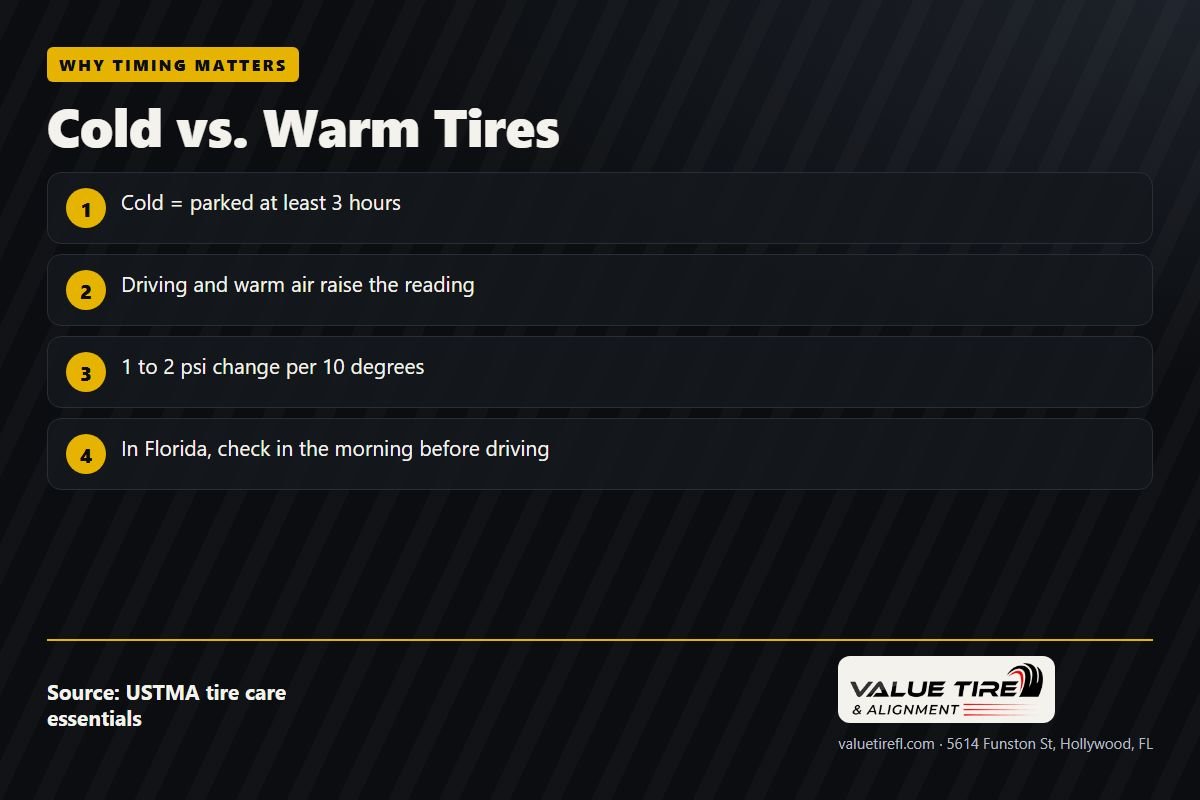
- “Cold” means parked for at least three hours. In Florida, check in the morning before you drive.
- Pressure shifts one to two pounds for every 10 degrees of temperature change.
- The TPMS light warns at 25% under-inflation. It does not replace a gauge.
- A tire that keeps losing air needs a technician, not more air.
A tire that runs a little low for weeks heats up, wears unevenly and can pick up internal damage, and you may never notice it from the driver’s seat. The fix takes five minutes and a gauge. Here is how to do it right, and why South Florida weather makes the timing matter.
What You Need
You need three things:
- A tire pressure gauge. A simple pencil gauge, a dial gauge or a digital one all work. Pick one you trust and keep using it, so your readings are comparable month to month.
- Your vehicle’s recommended pressure, from the driver’s door label or the owner’s manual.
- Access to air, either a home compressor or a pump at a gas station or shop.
Pressure is measured in PSI, or pounds per square inch. USTMA, the tire industry association, calls proper inflation perhaps the most important tire condition to monitor. It lets the tires support the vehicle and lets you control it. It also helps fuel economy.
Step by Step: How to Check Tire Pressure
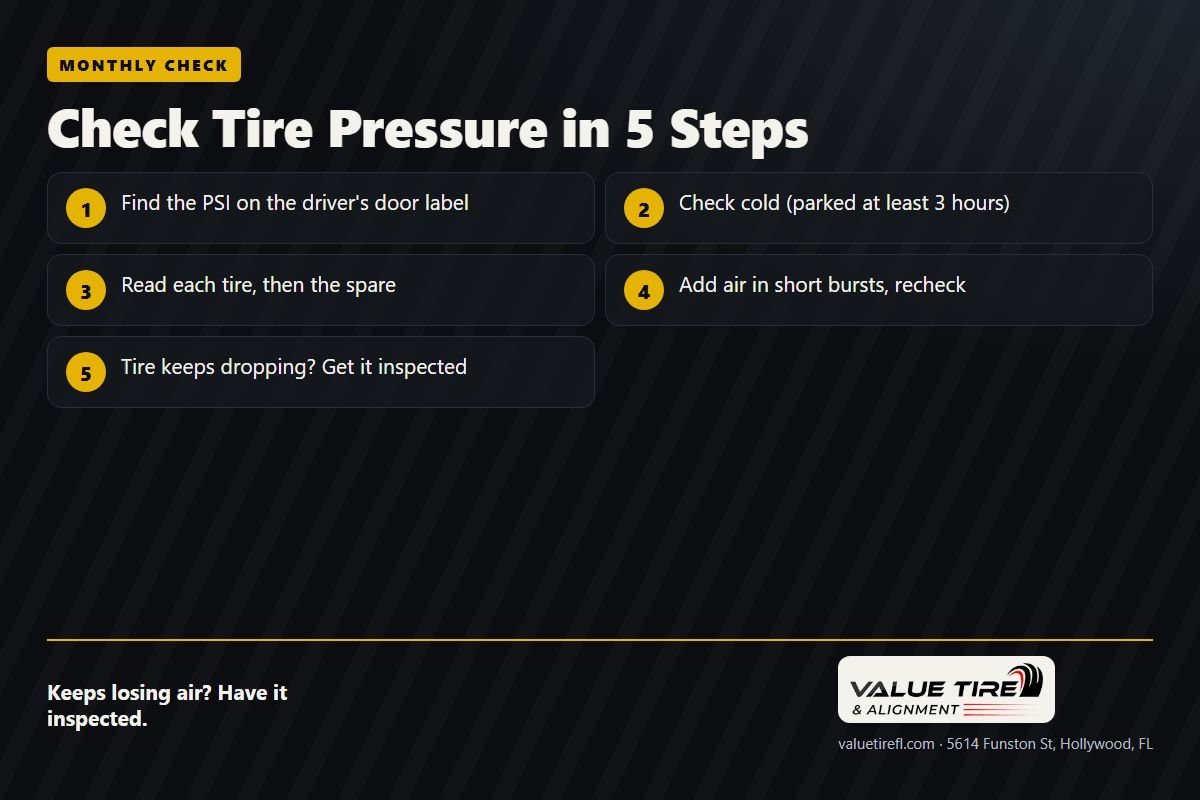
1. Find the correct number
Open the driver’s door and look for the label on the door edge or jamb. If you cannot find it, the owner’s manual lists the same figure. This is the pressure your vehicle needs. Do not use the maximum printed on the tire sidewall. That number describes the limit of the tire, not what your car should run.
| Where the number comes from | Use it as your target? |
|---|---|
| Driver’s door label | Yes |
| Owner’s manual | Yes |
| Number molded into the sidewall | No, it is a maximum for the tire |
| Dashboard TPMS light | No, it is a warning, not a reading |
2. Check when the tires are cold
Cold means the car has been parked for at least three hours. Driving heats the tires and raises the pressure, so a reading right after a drive looks higher than the true number. The simplest routine is to check first thing in the morning, before the car moves.
3. Read each tire
Remove the valve cap and press the gauge firmly onto the valve stem. A short hiss when it first seats is normal. Hold it steady until the reading settles, write it down, and replace the cap. Do all four tires, then the spare.
4. Add air if a tire is low
Add air in short bursts and recheck with your gauge between bursts. Stop when you reach the number on the label. If a cold tire reads above the label number, let a little air out and check again.
5. Recheck and note any pattern
After adding air, measure once more and put the caps back on. Keep a note of each month’s readings. If one tire is always the lowest, that tire has a reason, and the reason is worth finding.
If you add air at a station right after driving, that is fine to get a low tire back up. Just recheck the next morning when the tires are cold, since a warm reading overstates the real pressure.
Why Florida Heat Changes the Reading
Air expands when it warms. USTMA notes that inflation pressure increases in warm weather and decreases in cold weather by one to two pounds for every 10 degrees of temperature change. In South Florida, a tire that has been driven on hot roads or sat in afternoon sun will read higher than the same tire first thing in the morning.
The practical lesson is simple. If you check late in the day or right after driving, you may see a higher number than the tire really holds, and you may skip air it needs.
The one to two pound rule in practice
A swing of 10 degrees moves the pressure about one to two pounds, and a bigger swing moves it more. Checking at the same time of day, cold and before driving, takes the weather out of your comparison. It is how you tell a real leak from a temperature swing.
Pressure is only one thing to watch. Our guide to the signs your tires need replacement covers what to look for beyond the gauge.
Why Pressure Matters
USTMA is direct about the risks of getting it wrong. Under-inflated tires build up excess heat and stress, which causes irregular wear and internal damage. Over-inflated tires are more likely to be cut, punctured or damaged when they hit an obstacle such as a pothole. Correct pressure also helps fuel economy.
Do Not Forget the Spare
A spare sits for months without anyone looking at it. USTMA specifically says not to forget your spare. Check it with the same gauge, and use the pressure listed for the spare on the label or in the owner’s manual.
Why the Dashboard Light Is Not a Substitute for a Gauge
Tire Pressure Monitoring Systems, or TPMS, detect loss of inflation pressure and warn the driver when tires are 25% under-inflated. For many vehicles, USTMA says, that warning may be too late to prevent damage. USTMA is clear that TPMS is not a replacement for monthly checks with a gauge.
Think of the light as a backstop. The gauge in your hand is how you catch a slow loss before the dashboard notices. If the light does come on, check all four tires and the spare, then get the car to a shop if the pressure will not hold.
Signs the Pressure Problem Is Really a Leak
If you have to add air to the same tire again and again, stop treating it as routine. Look for these signs:
- One tire is lower than the others every month.
- A nail, screw or other object is visible in the tread.
- You hear hissing from the tire or valve.
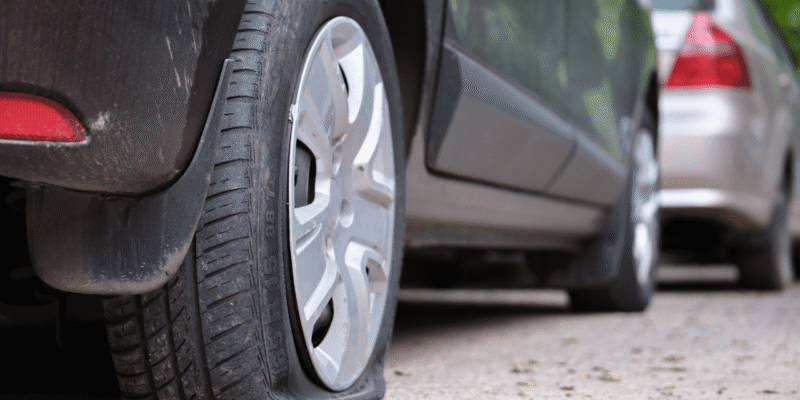
- The tire looks flat on the bottom, bulged or damaged.
A slow leak can come from a puncture, a valve problem or the wheel itself. Do not drive on a flat or visibly damaged tire. Have a technician inspect it. A plug or a sealant such as Fix-a-Flat is a temporary, roadside-only measure to get you to a shop, not a repair. Fix-a-Flat is a branded product, and naming it is not an endorsement.
According to USTMA, a proper repair means the tire is removed from the wheel and inspected inside, the injury is filled with a plug and the inner liner is sealed with a patch. A plug alone is an unacceptable repair. Repairs belong only in the tread area, the injury cannot be greater than 1/4 inch (6 mm), and damage to the sidewall or shoulder means replacement. Our article on why tires lose air and what the repair options are goes deeper.
Frequently Asked Questions
How often should I check my tire pressure?
Check it at least once a month, and again before a long trip, a heavy load or towing a trailer. That is the USTMA guidance.
Where do I find the right PSI for my car?
Look at the label on the driver’s door or in the owner’s manual. The number molded into the tire sidewall is a limit for the tire, not the pressure your vehicle needs.
Why check tires when they are cold?
Driving heats the tires and raises the reading. USTMA defines cold as parked for at least three hours, so an overnight rest is the easy way to get an honest number.
Does temperature change tire pressure?
Yes. USTMA says inflation pressure rises in warm weather and falls in cold weather by one to two pounds for every 10 degrees of temperature change.
My TPMS light is off. Do I still need a gauge?
Yes. USTMA says TPMS warns when tires are 25% under-inflated, which for many vehicles may be too late to prevent damage, and it is not a replacement for monthly checks with a gauge.
Should I check the spare tire?
Yes. USTMA specifically reminds drivers not to forget the spare. Use the pressure listed for it on the label or in the owner’s manual.
What if a tire keeps losing pressure?
Do not just keep adding air. A tire that needs air again and again can have a puncture, a valve problem or a wheel leak, so have a technician inspect it. Do not drive on a flat or visibly damaged tire.
Next Step
If a tire keeps dropping, or you want a technician to look at your tires, Value Tire & Alignment at 5614 Funston St, Hollywood, FL 33023 offers tire services including flat tire repair assessment, rotation and balancing, wheel alignment, and new and used tires. You can book a service, request a tire quote or call (954) 987-1405. You can also read about our tire services and wheel alignment.
Sources: USTMA, Tire Care Essentials; USTMA, Tire Repair Basics.