Quick answer: Rotation moves your tires between positions so they wear evenly. Balancing adds small weights so each wheel spins smoothly without vibrating. Follow your owner’s manual for rotation timing. If it gives none, USTMA recommends every 5,000 to 8,000 miles. Have balance checked when you feel a vibration or after a tire is mounted.
- Rotation, balancing and alignment are three different jobs. One does not replace another.
- Your owner’s manual sets the rotation interval. USTMA suggests 5,000 to 8,000 miles when the manual is silent.
- Reset tire pressure to the vehicle maker’s specification after every rotation.
- A vibration, pulling or uneven wear is a reason to get the tires inspected, not to keep driving and hope.
Rotation, Balancing and Alignment: Three Different Jobs
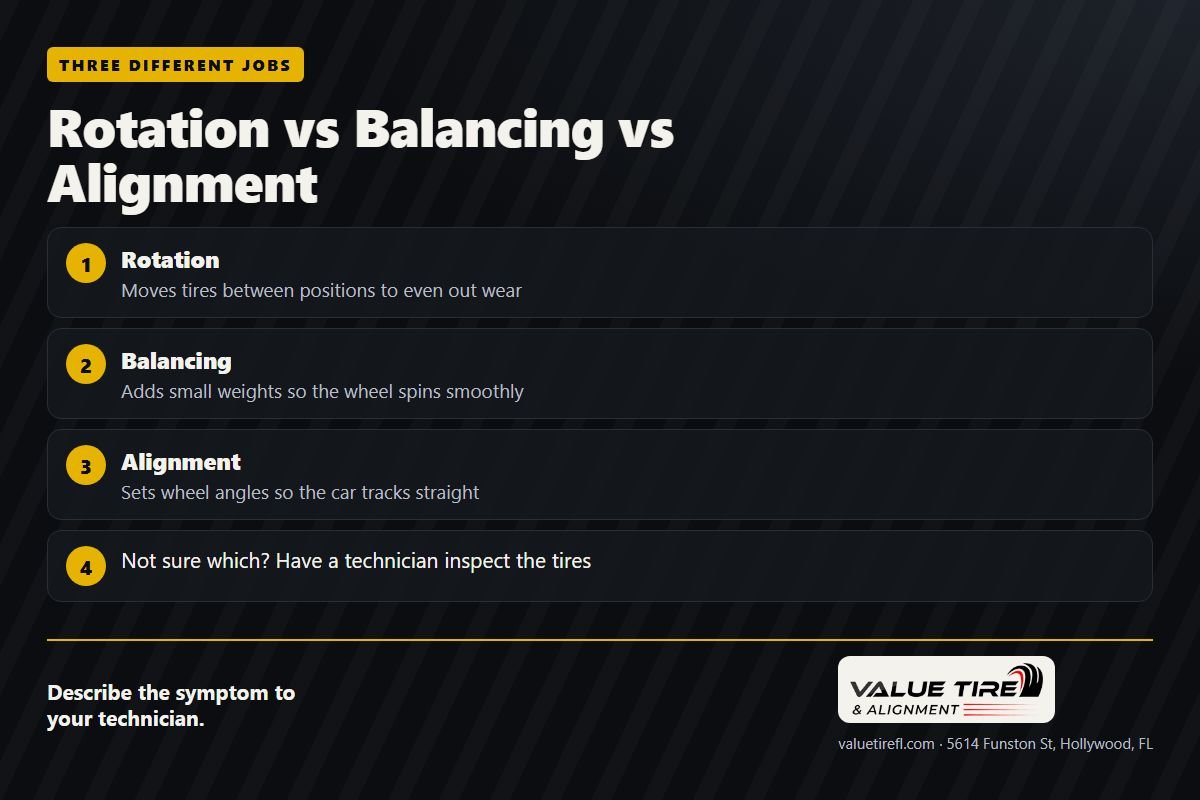
Drivers often use these words as if they meant the same thing. They do not. Each one fixes a different problem, and a shop can only fix the right problem if you describe the symptom clearly.
| Service | What it does | When to schedule it |
|---|---|---|
| Rotation | Moves tires to different positions so wear evens out | Per your owner’s manual; every 5,000 to 8,000 miles if the manual gives none (USTMA) |
| Balancing | Corrects weight distribution so the wheel spins smoothly | When you feel a vibration, when a tire is mounted, and periodically with an alignment check |
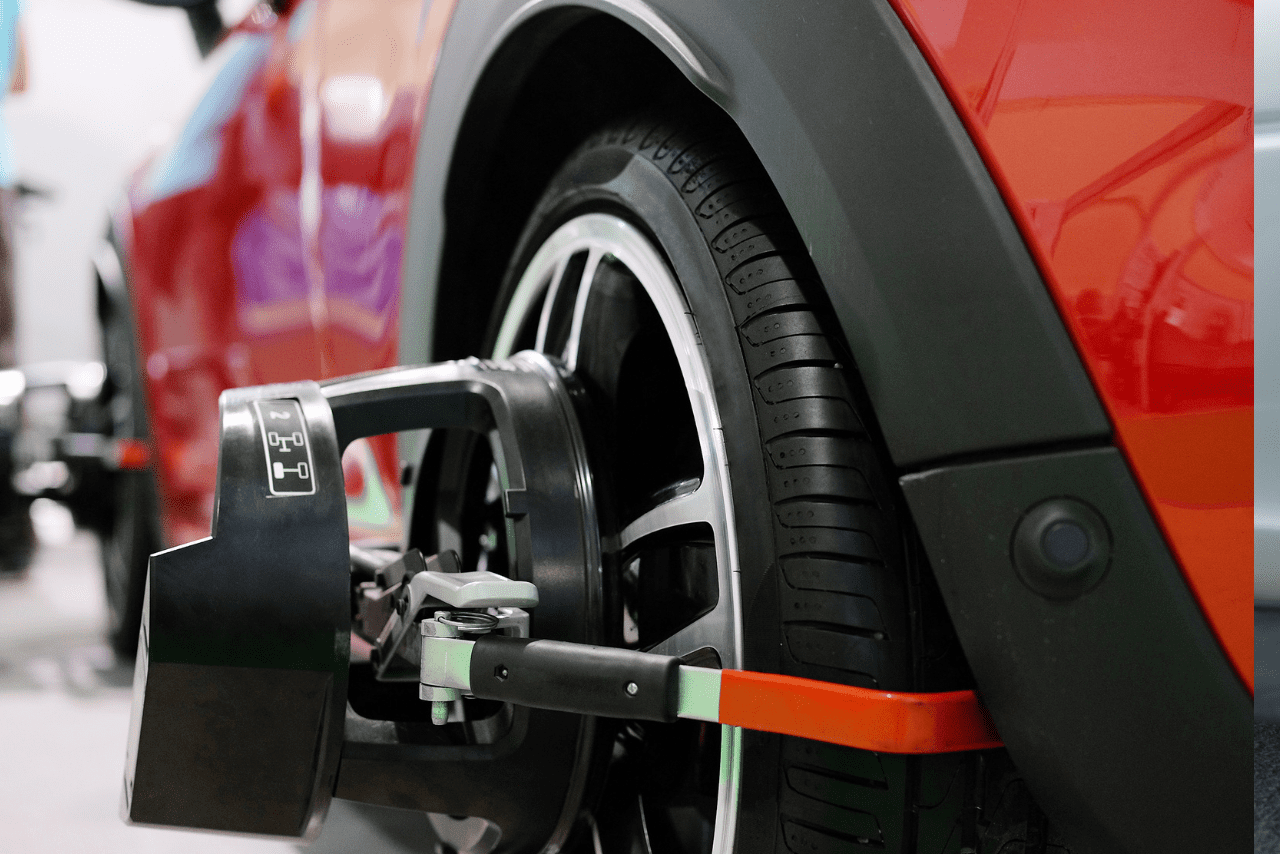
| Alignment | Sets the wheel angles so the car tracks straight | At any sign of trouble such as pulling, and periodically, as your manual specifies |
Tire Rotation
What Rotation Fixes
The tires on your car do not wear at the same rate. Front tires handle steering and, on front-wheel-drive cars, most of the driving force. Rear tires carry different loads. Left alone, each position develops its own wear pattern.
Rotating your tires based on the recommendations in your owner’s manual can prevent irregular tire wear. That helps your set wear down more evenly and keeps the tires working as a matched group.
How Often to Rotate
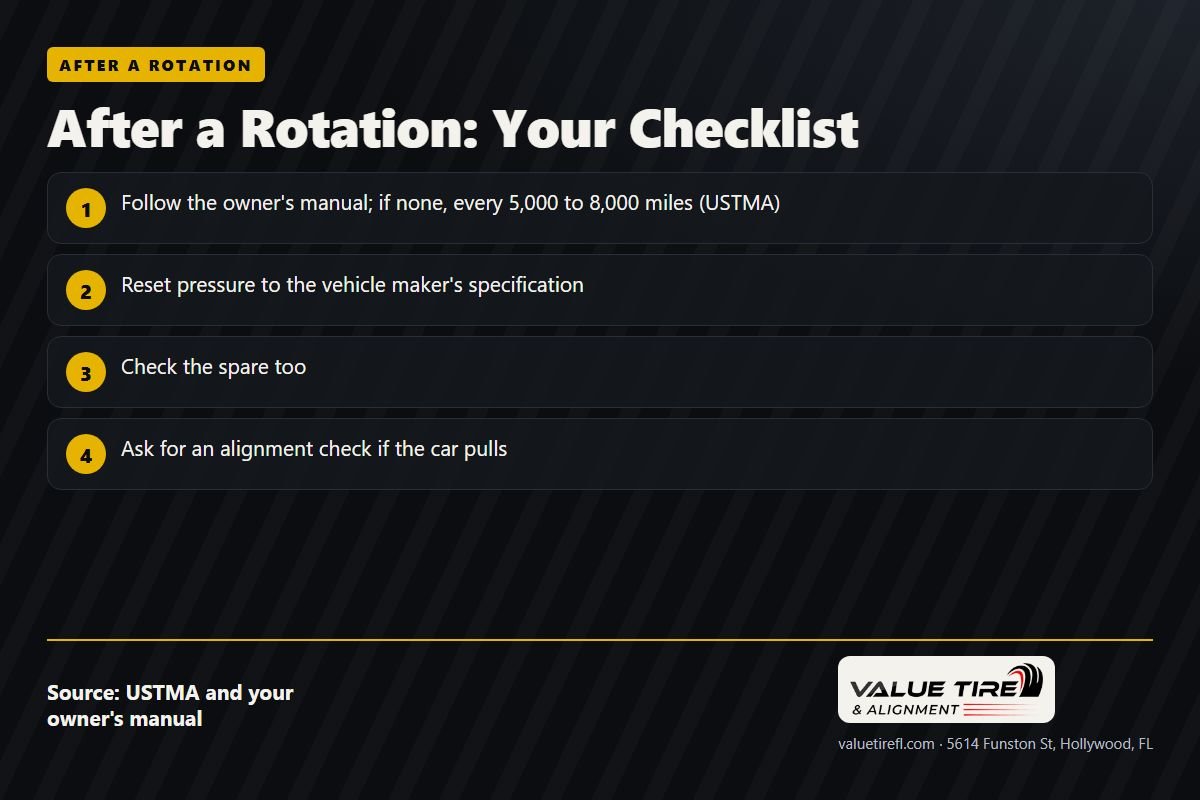
Start with your vehicle owner’s manual. It is the authority for your car. If the manual does not specify a rotation period, USTMA recommends rotating every 5,000 to 8,000 miles.
The pattern matters too. It depends on things like drive type and tire design, so do not assume a pattern you saw online fits your vehicle. A technician can follow the correct one for your car.
Reset Pressure Afterwards
Once the rotation is done, make sure the inflation pressure is set to the vehicle manufacturer’s specification. You will find it on the label on the driver’s door or in the owner’s manual. Do not forget the spare.
USTMA also advises checking pressure at least once a month, with the tires cold, meaning the car has been parked for at least three hours. A tire pressure monitoring system is not a replacement for a gauge. It warns when a tire is 25% under-inflated, and for many vehicles that warning may come too late to prevent damage.
Tire Balancing
What Balancing Fixes
No tire and wheel assembly is perfectly even all the way around. A heavy spot makes the wheel hop or wobble as it spins. You usually feel it as a vibration that you notice while driving at speed.
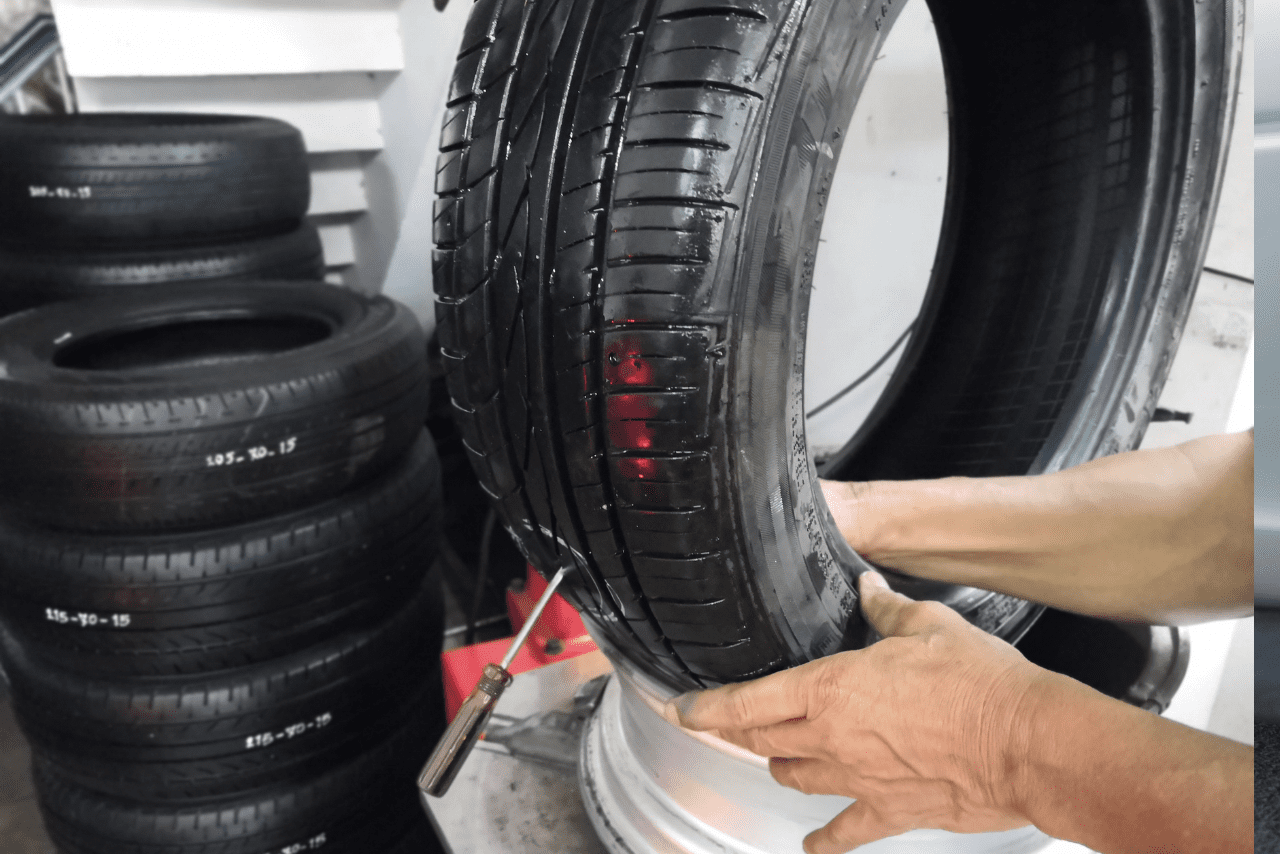
A technician spins the assembly on a balancing machine, finds the heavy spot and attaches small weights to the wheel to offset it. The result is a wheel that turns smoothly. Balancing does not move tires between positions, and it does not change wheel angles.
When to Rebalance
USTMA does not give a mileage number for balancing. Instead, it says to have your alignment checked at any sign of trouble, and periodically along with your tire balance, as specified by your owner’s manual. In practice, that gives you these moments to think about balance:
- You feel a new vibration while driving.
- A tire has been mounted on a wheel, such as with new or used tires.
- You are already at the shop for a wheel alignment check.
If you are shopping for tires, see our pages on new tires and used tires.
Signs You Are Overdue
Watch for these signs:
- Vibration: a shake you feel through the steering wheel or the seat. Balance is a common cause, but damage, alignment and suspension can cause it as well.
- Uneven wear: high and low areas or unusually smooth patches on the tread. USTMA suggests looking over your tires for these each month.
- Pulling: the car drifts to one side. USTMA names this as a reason to have alignment checked.
- A pothole or curb strike: hitting a road hazard can cause alignment issues, and it can damage a tire too.
Do not keep driving on a tire that looks damaged, bulged or low. Have a technician inspect it. For wear that may mean replacement, read our guide to the signs you need new tires. USTMA says tread at 2/32 of an inch is the point to visit a tire shop.
How the Three Services Work Together
Think of it as a routine, not a single fix. Rotation keeps wear even across the set. Balancing keeps each wheel smooth. Alignment keeps the car tracking straight. If one is off, it can undo the benefit of the others.
For example, a car that pulls to one side can wear a tire unevenly, and rotating that tire will not cure the cause. In the same way, balancing a tire that already has damage will not make it safe. That is why a technician should inspect the tires first and then recommend the right service.
USTMA also lists the basics worth checking between visits: inflation pressure, tread depth, rotation and alignment. Tires have built-in wear bars, and when the tops of those bars are flush with the tread, the tire needs to be replaced.
Questions to Ask Your Technician
- What rotation pattern does my vehicle call for?
- Did you set the pressure to the vehicle maker’s specification, including the spare?
- Is the vibration I described a balance issue, or do you see something else, such as tire damage?
- Should I have my alignment checked at this visit?
What to Expect at the Shop
For a rotation, the technician removes the wheels, moves them to the right positions and reinstalls them. Then they set the pressure to the vehicle maker’s specification. For balancing, each wheel goes on a balancing machine and gets weights where needed.
It is also a good time to ask the technician to look over the tires for uneven wear, damage or alignment clues. Tell them what you felt and when you felt it. That detail helps more than a guess at the cause. See our tire services page for more.
Frequently Asked Questions
How often should tires be rotated?
Follow your vehicle owner’s manual. If it does not specify a rotation period, USTMA recommends every 5,000 to 8,000 miles.
What is the difference between tire rotation and balancing?
Rotation moves tires to different positions so they wear more evenly. Balancing corrects uneven weight distribution in the wheel and tire assembly so it spins smoothly instead of shaking.
Will a tire rotation fix a vibration?
Not usually. A vibration often points to a balance problem, but it can also come from tire damage, alignment or suspension wear. Have a technician inspect it rather than guessing.
Do I need to reset tire pressure after a rotation?
Yes. USTMA says to set the inflation pressure to the vehicle manufacturer’s specification once the rotation is done.
Is balancing the same as alignment?
No. Balancing deals with the weight distribution of the wheel and tire. Alignment deals with the angles of the wheels relative to the vehicle and the road.
Do new tires need balancing?
Whenever a tire is mounted on a wheel, its balance should be checked, because every tire and wheel is slightly different. Ask the shop to confirm balancing is part of your tire installation.
Do all vehicles rotate tires the same way?
No. The rotation pattern depends on factors such as drive type and tire design, so follow your vehicle or tire maker’s instructions.
Next Step
Ready to schedule? Book a service at Value Tire & Alignment, 5614 Funston St, Hollywood, FL 33023, or request a quote. You can also call (954) 987-1405.
Sources: USTMA, Tire Care Essentials.